Scaling Behavior Foundation Model for Humanoid Robots
Technical Report
* Equal contribution
Abstract
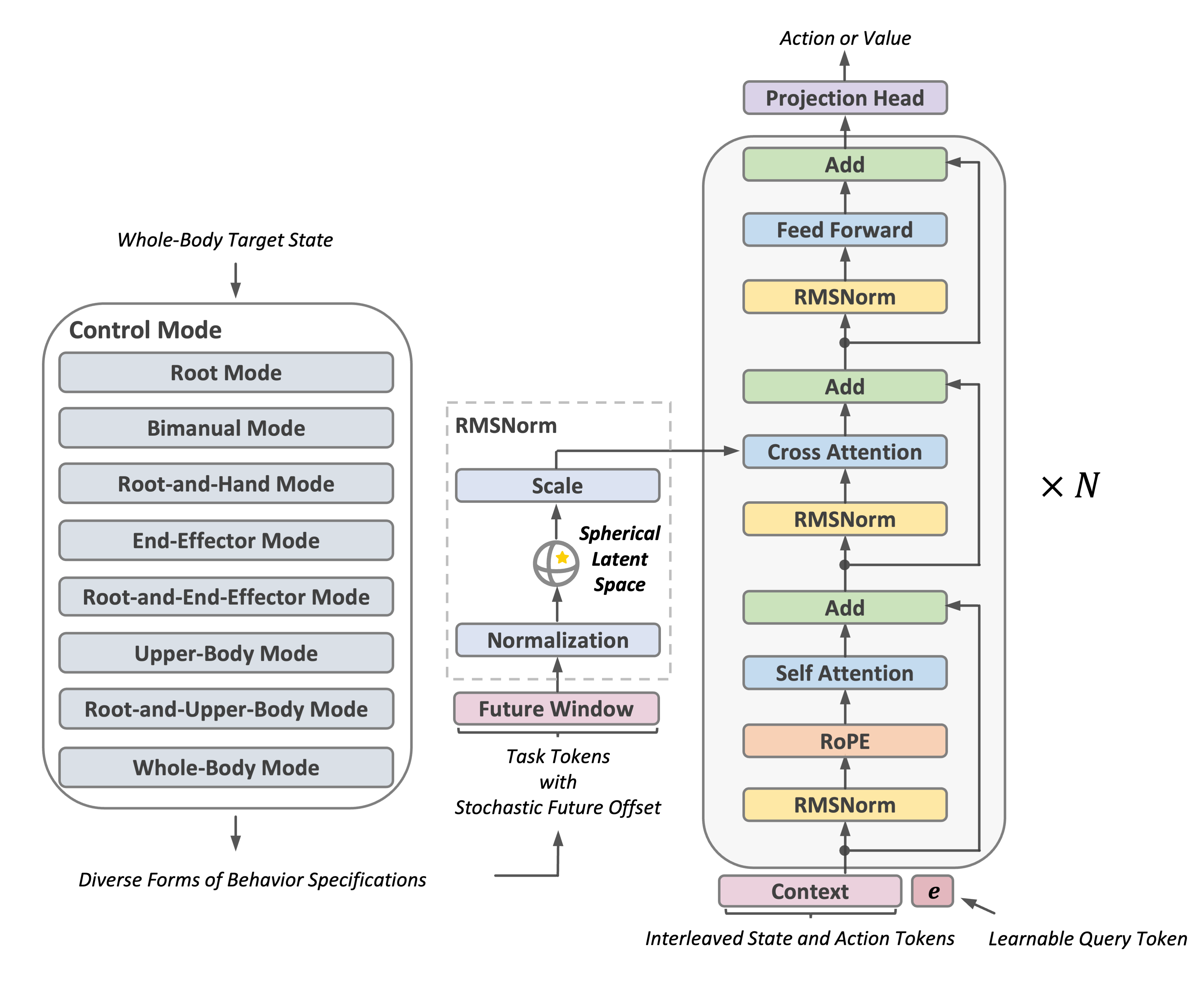
Humanoid control requires natural whole-body coordination, precise real-time responses to control signals, and robust generalization across diverse environmental contexts, making it a cornerstone for generalist embodied agents. Behavior Foundation Models (BFMs) have recently emerged as a promising solution to address these challenges by leveraging large-scale behavioral data to achieve superior expressiveness, versatility and generalization. However, despite growing interest in scaling BFMs to further improve their capabilities, it remains unclear how key factors, including the learning paradigm, behavioral data and model architecture should be coordinated to enable effective scaling. In this work, we revisit the scaling recipe for BFMs and demonstrate that substantial performance gains can be achieved through the coordination of three core components: 1) the learning paradigm of motion tracking that reformulates diverse humanoid control problems as the reproduction of integrated whole-body behaviors in the global frame; 2) the strategic synergy between on-policy rollout quantity and reference motion diversity; and 3) the expressive and scalable model architecture termed the Humanoid Transformer that facilitates the natural emergence of structured behavioral representations. Through extensive experiments in both simulation and real-world deployment, we demonstrate that our approach yields significant improvements in control fidelity and task generalization, reducing Mean Per-Keypoint Position Error (MPKPE) on the test set by over 10% in local mode and 82% in global mode compared with existing humanoid controllers. These results establish BFM as a principled and effective foundation for scalable and general-purpose humanoid control.
Gallery
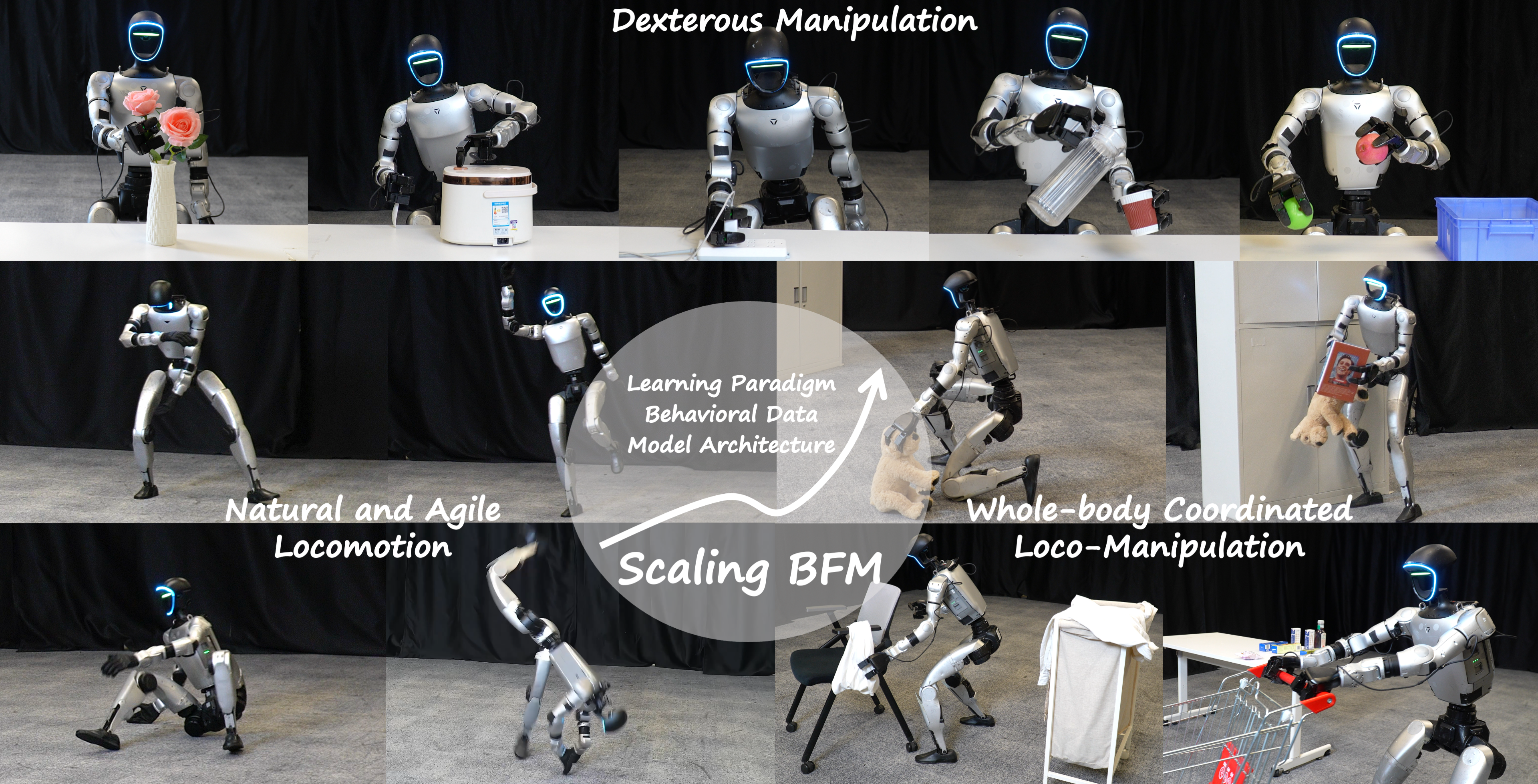
Dexterous Manipulation
Natural and Agile Locomotion
Whole-body Coordinated Loco-manipulation
Versatile Control under Sparse Constraints
Scaling On-policy Data
Mode
Mode
Mode
Mode
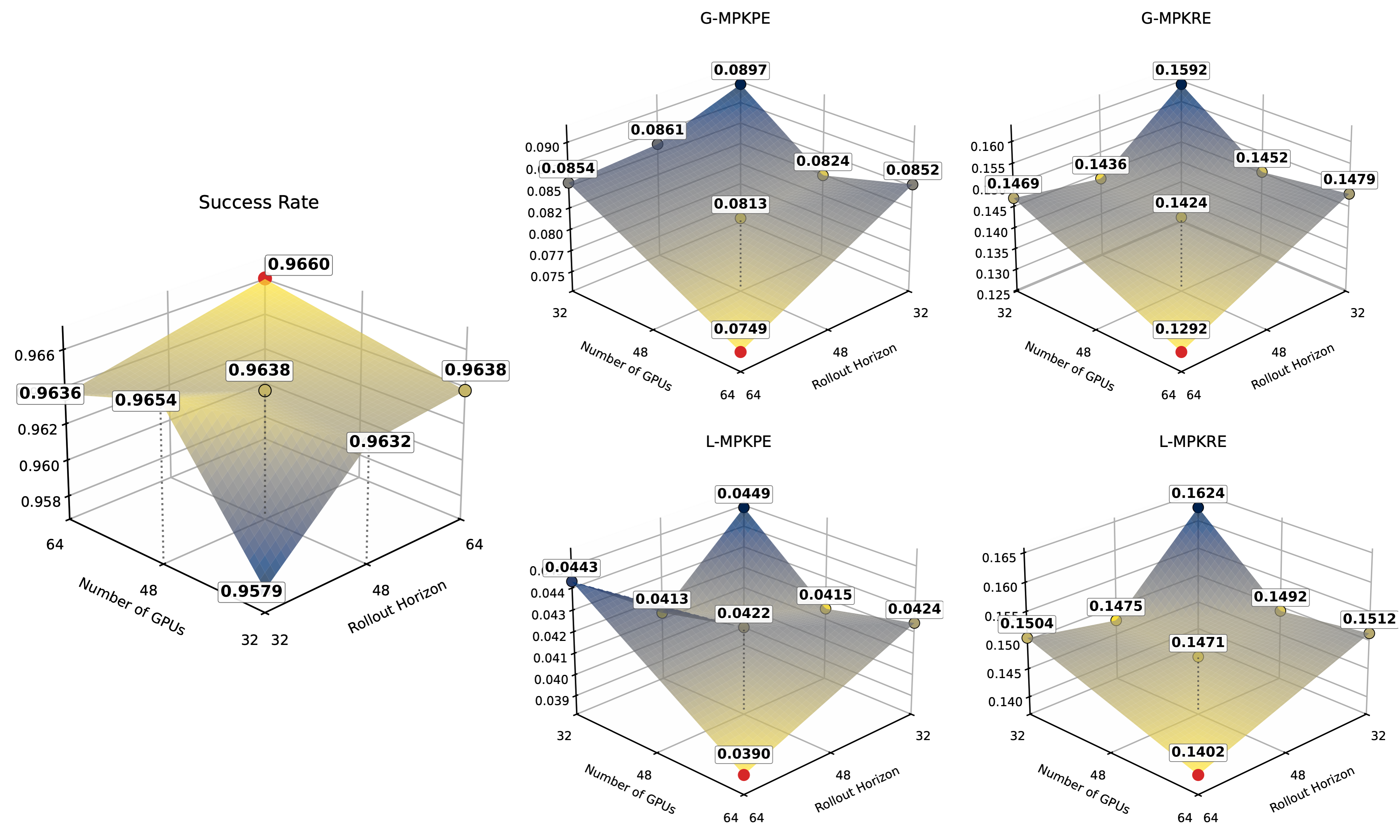
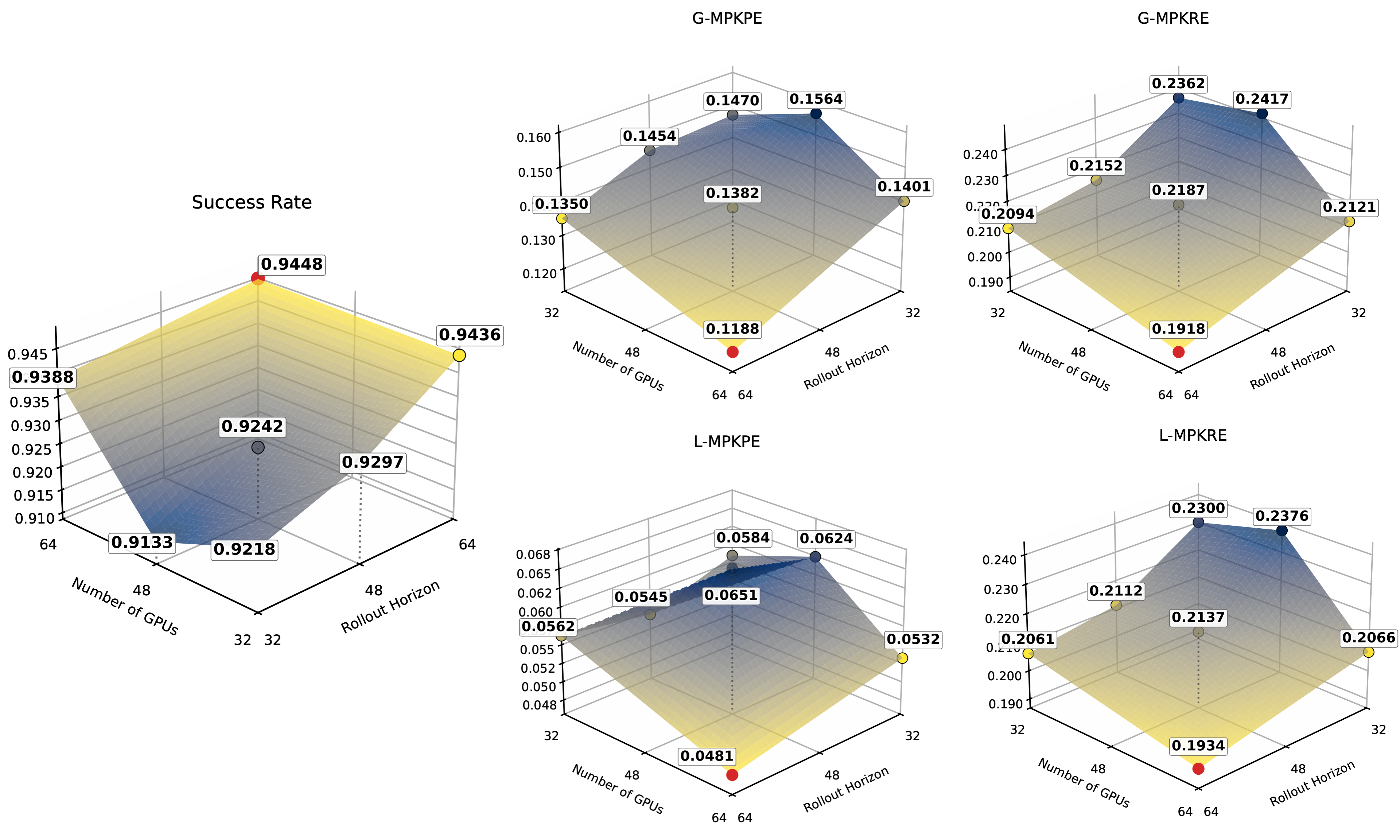
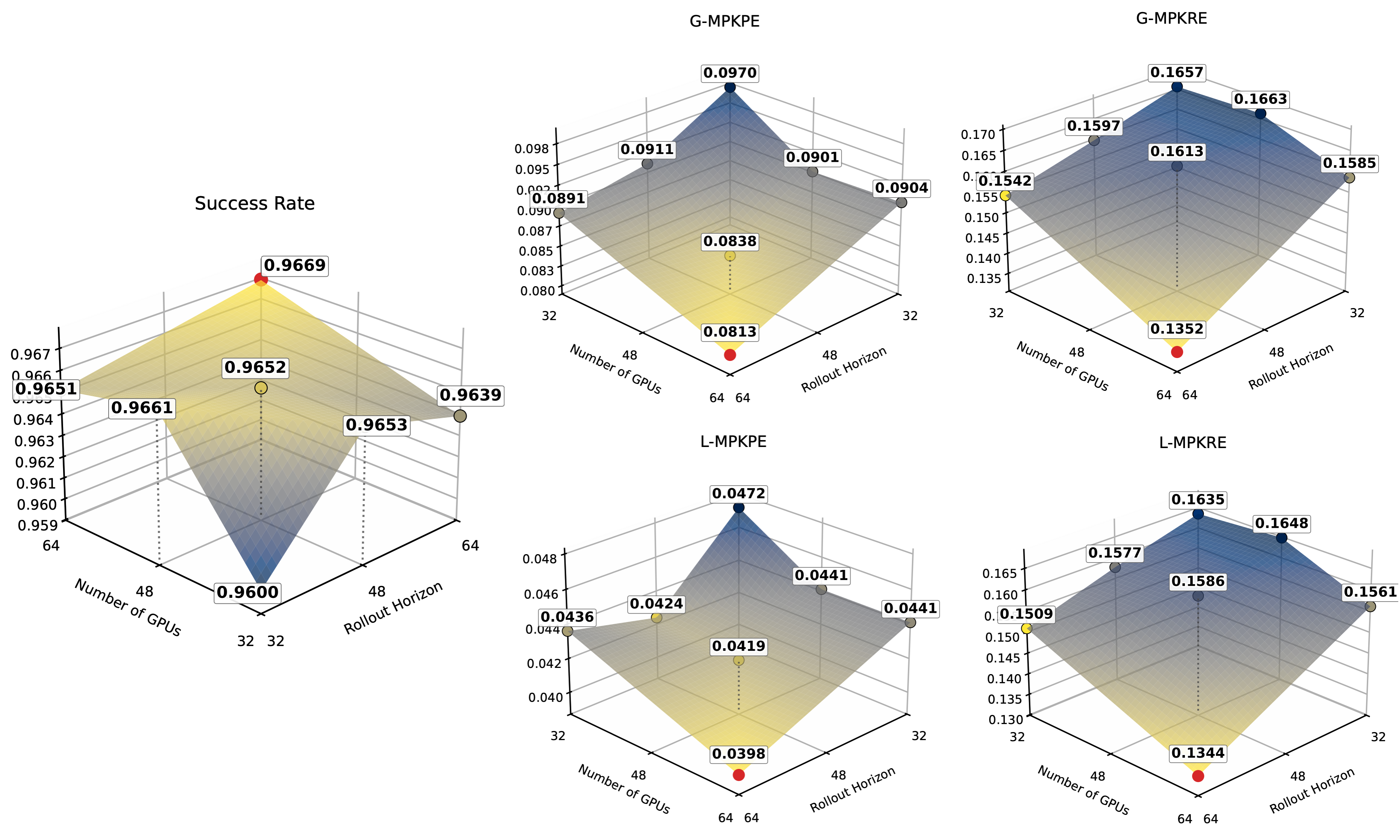
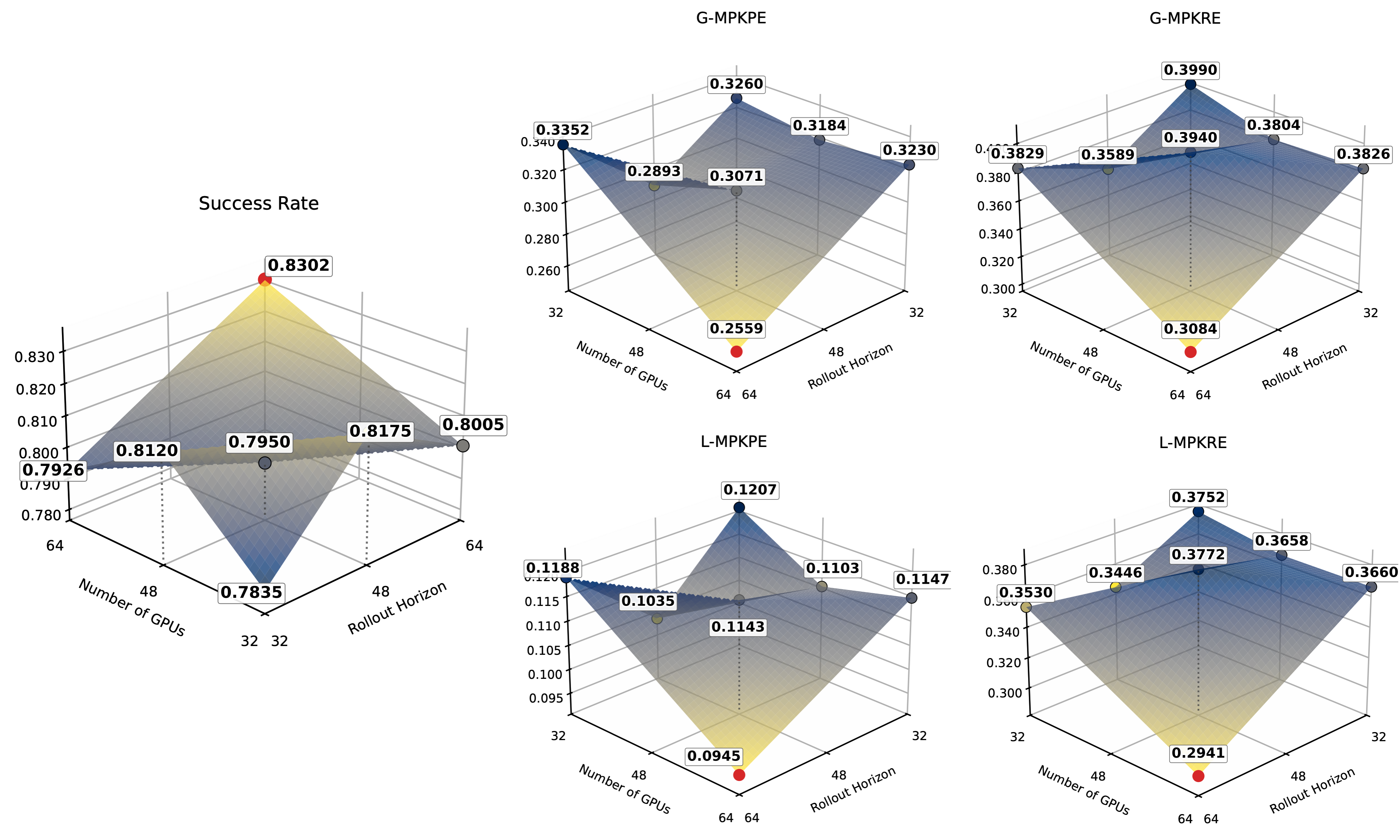
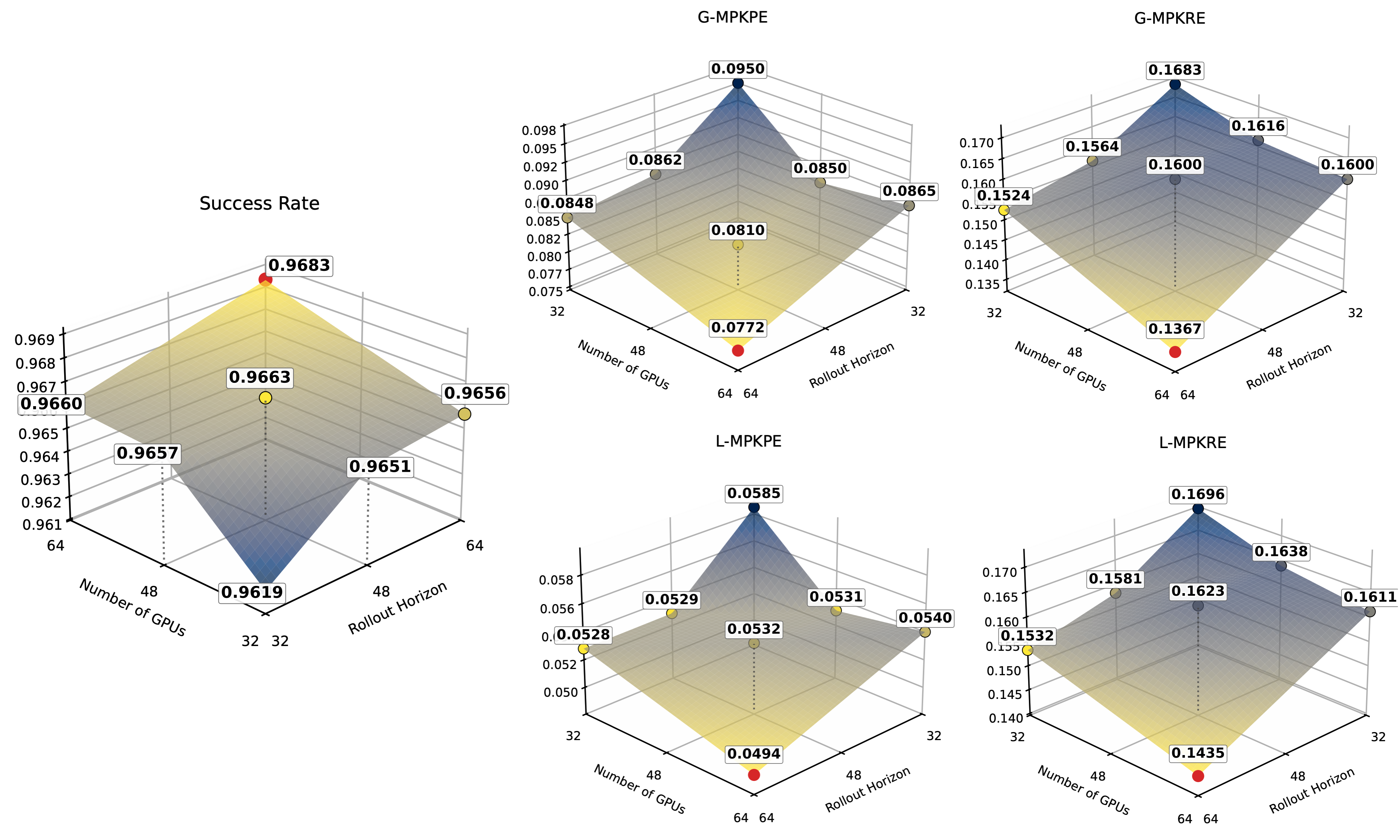
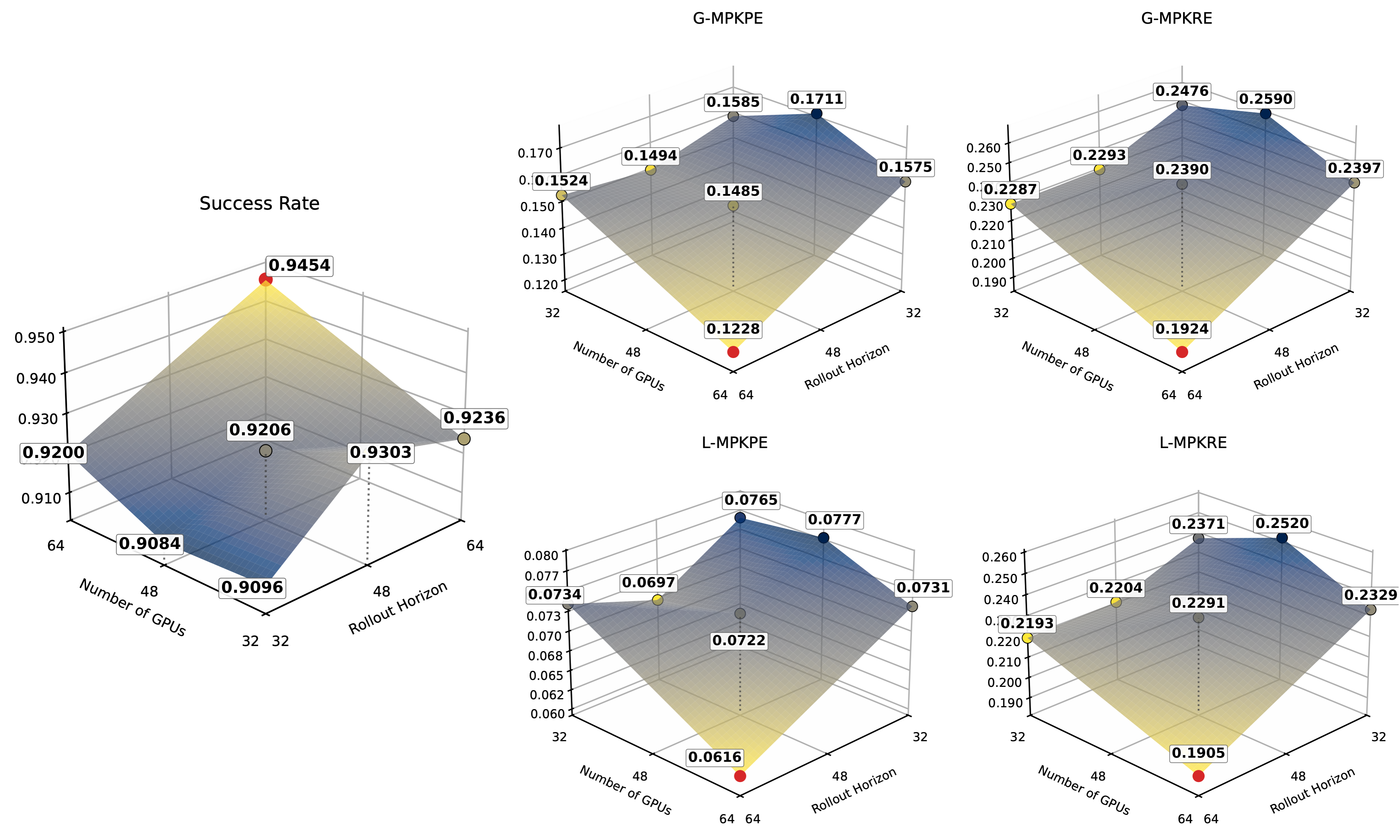
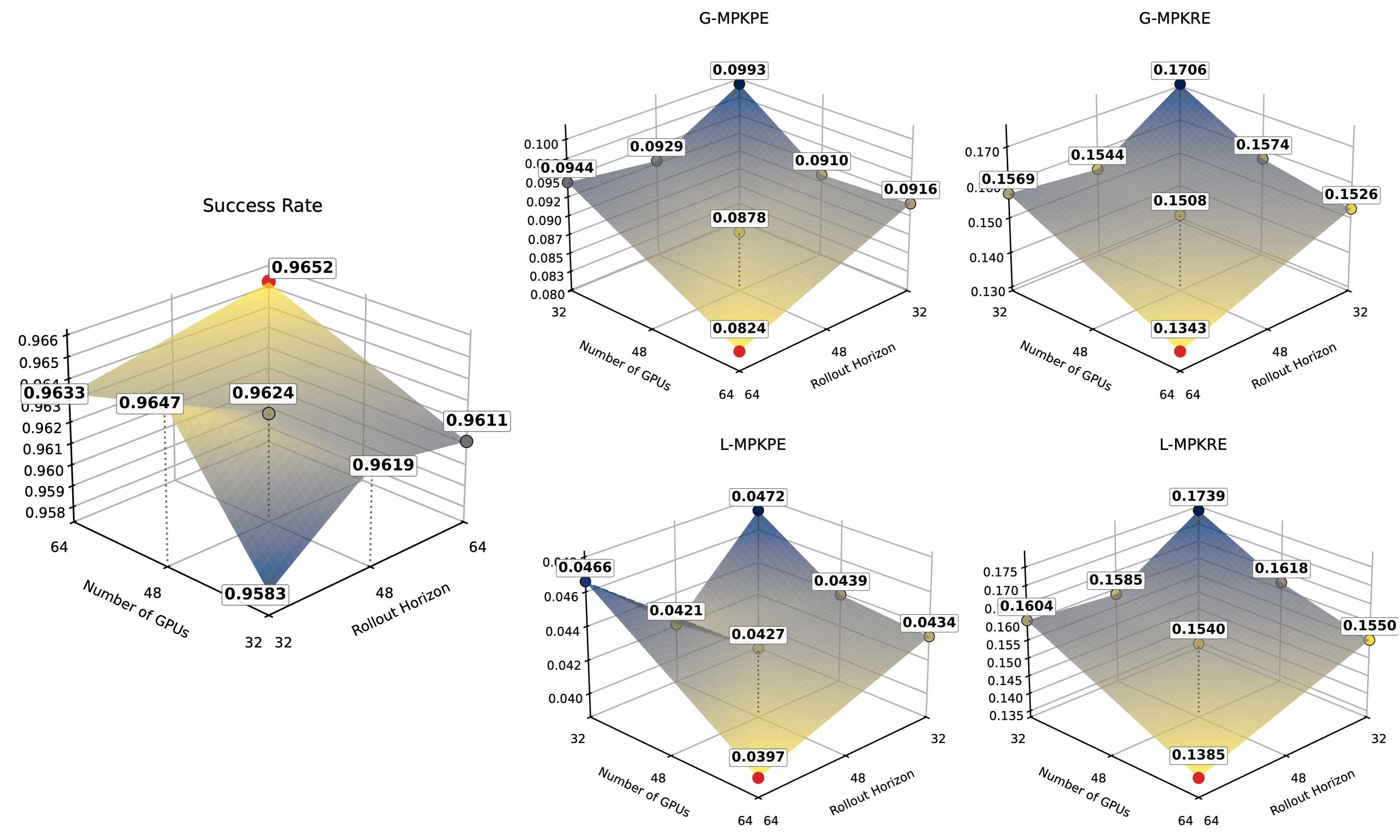
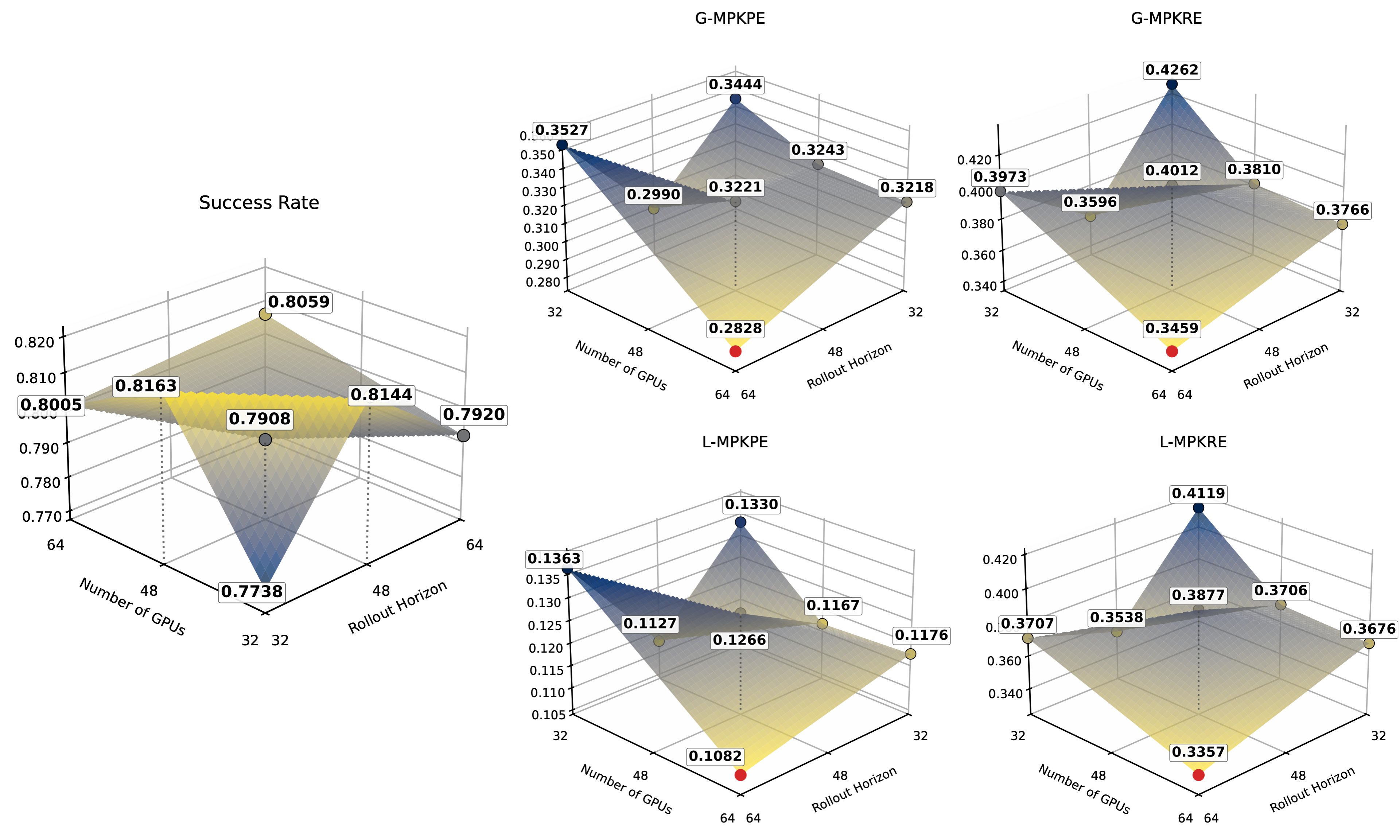
Jointly scaling the width (parallel environments) and depth (rollout horizon) of on-policy data collection consistently improves BFM performance across diverse control modes and test sets, with the largest configuration achieving the strongest overall results. These gains likely arise from larger amounts of on-policy experience, which yield more reliable PPO optimization. In contrast, scaling either dimension alone does not consistently improve performance, suggesting that effective on-policy scaling requires a balanced increase in both width and depth rather than expanding either dimension in isolation.
Scaling Reference Motions
Mode
Mode
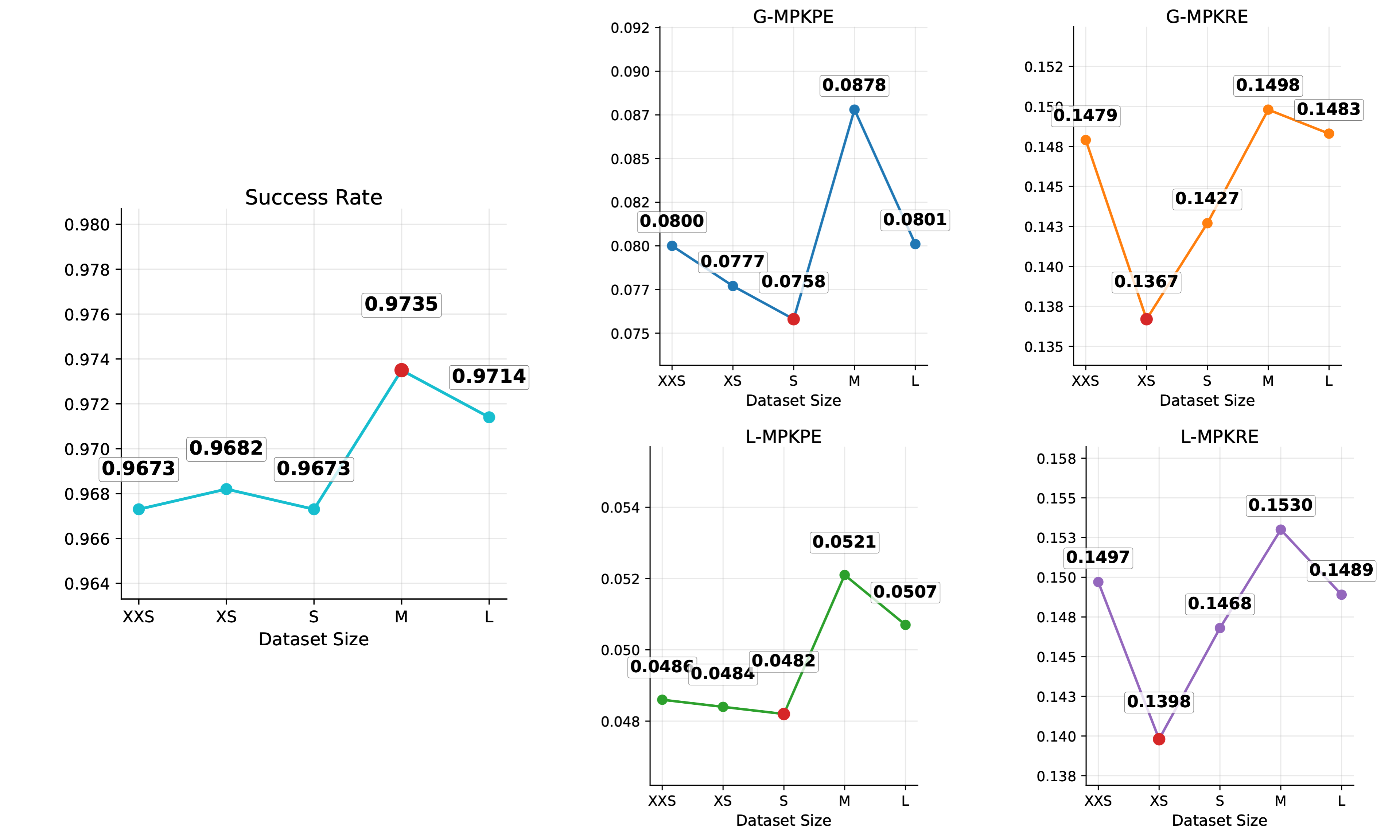
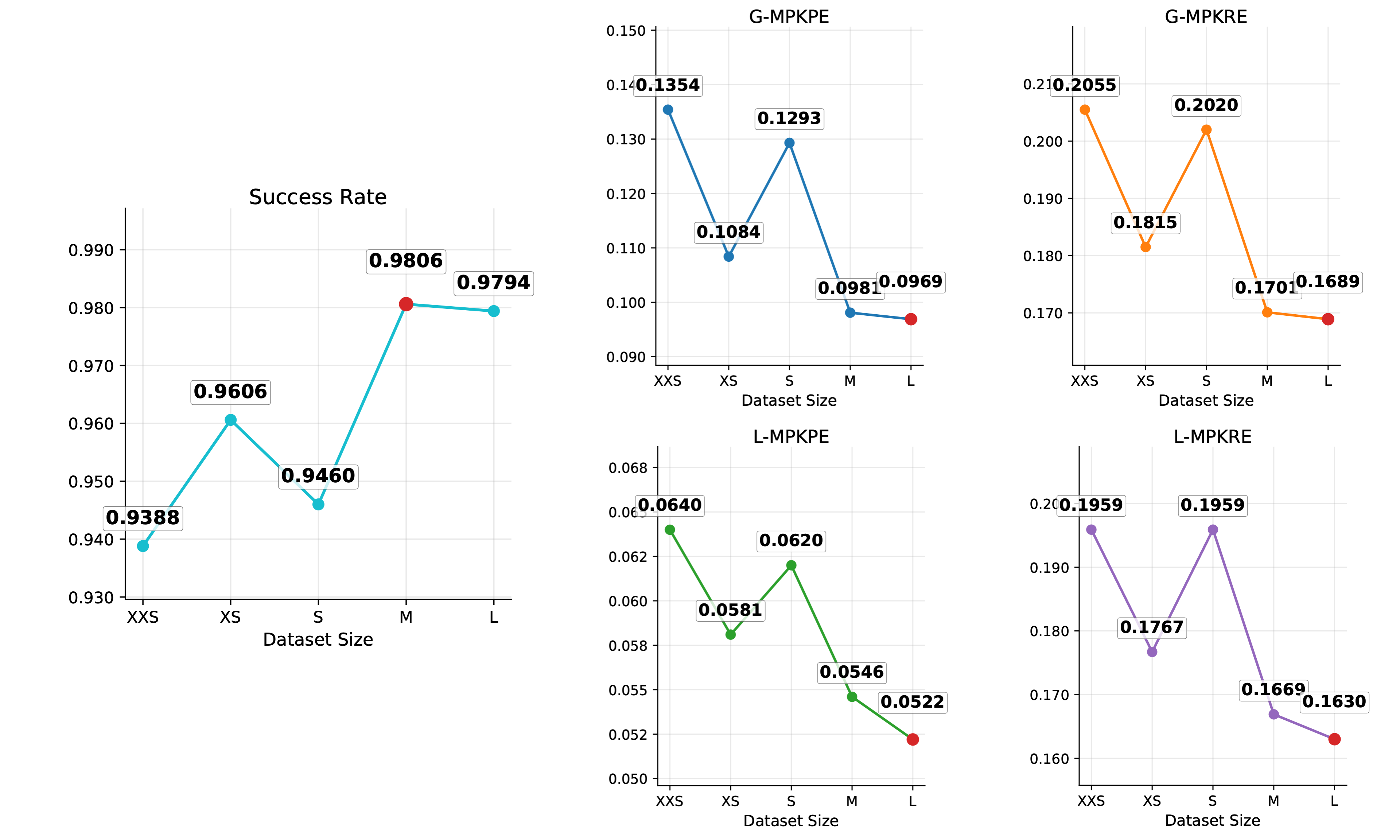
Mode
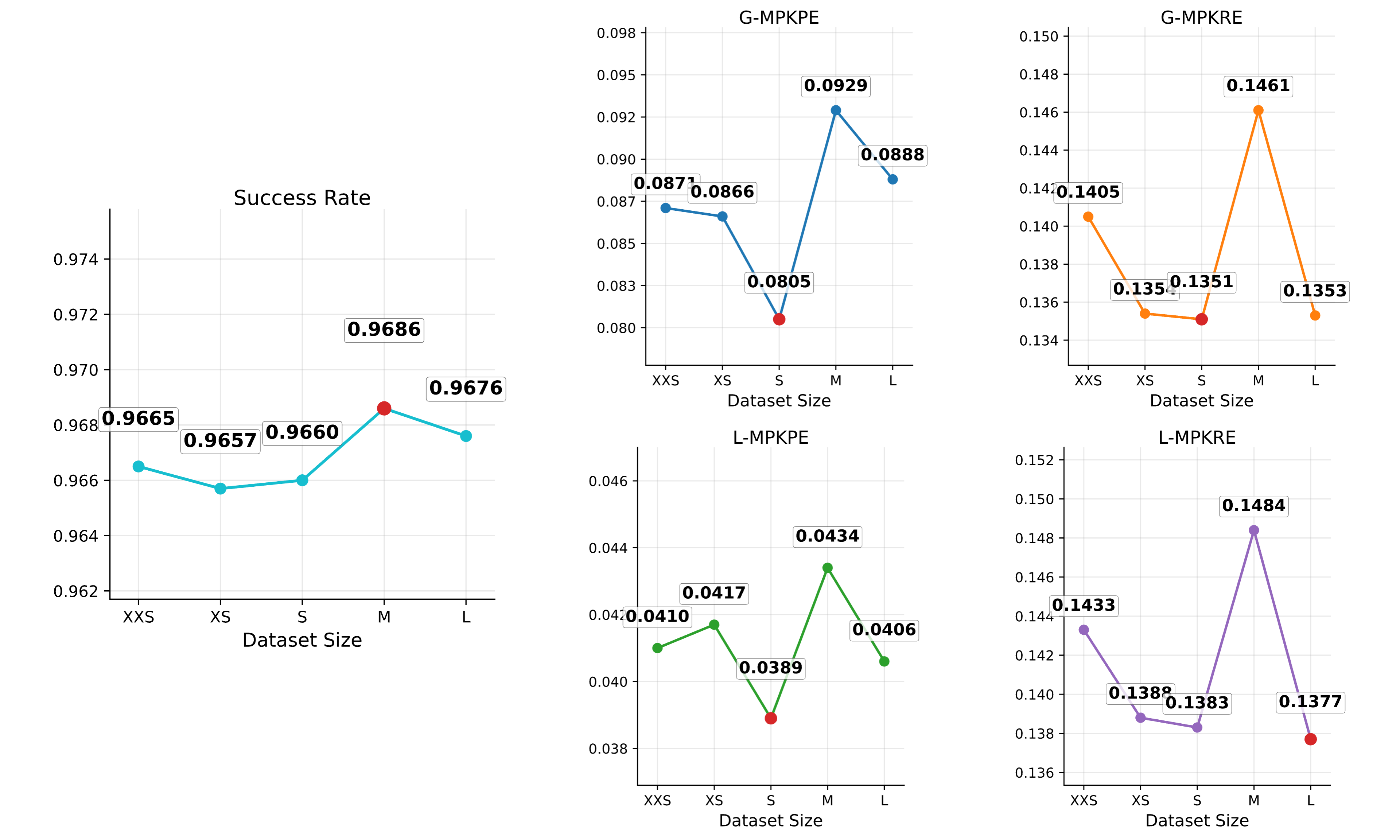
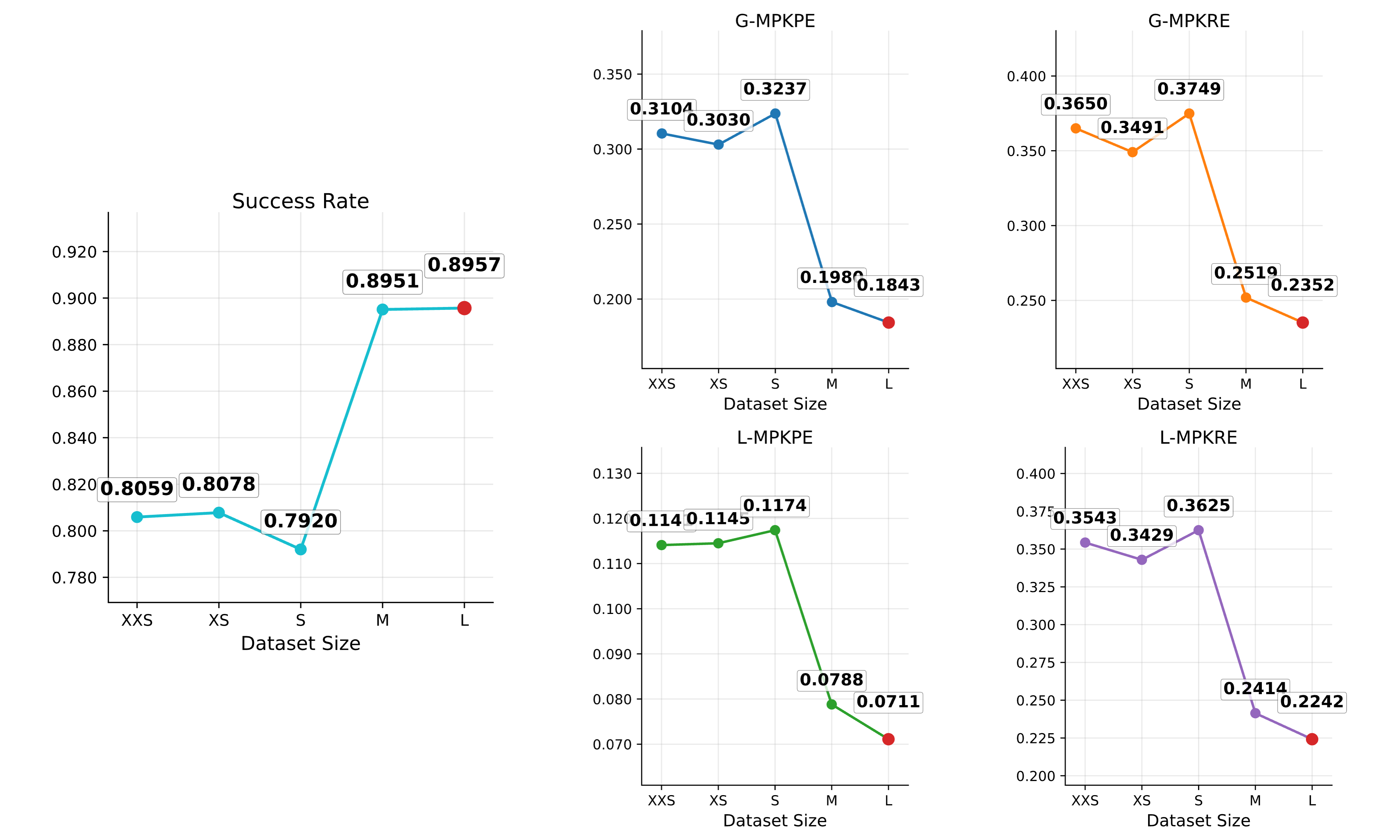
Mode
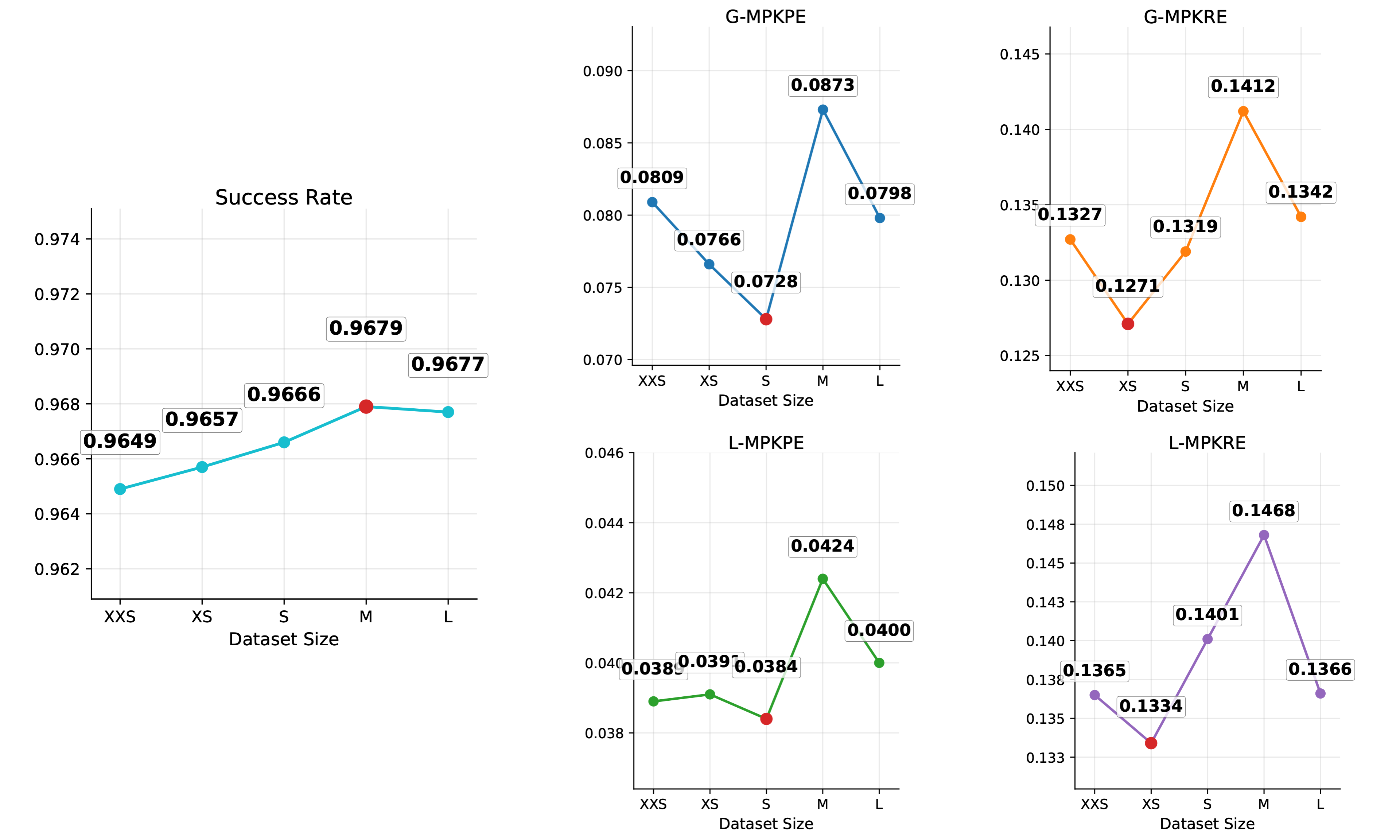
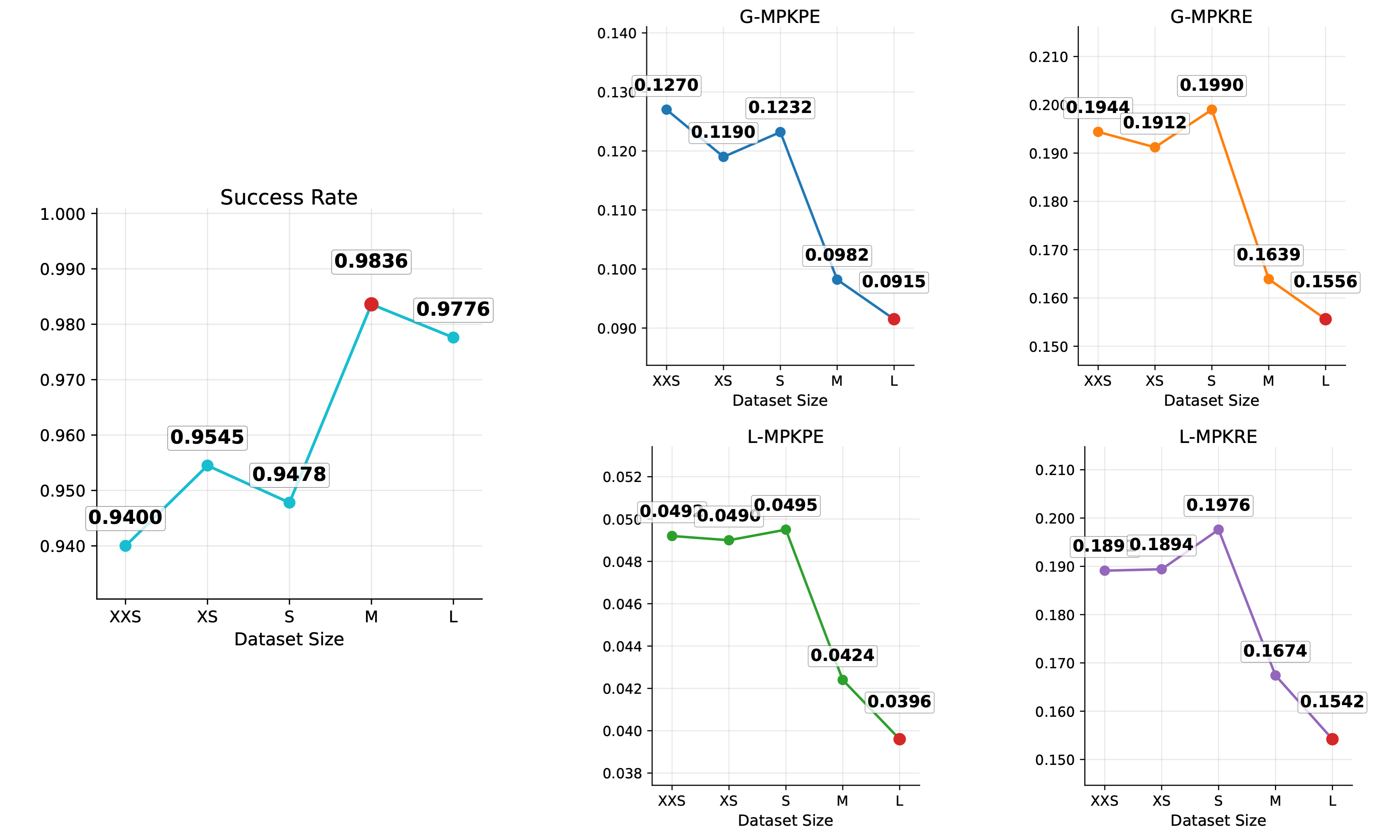
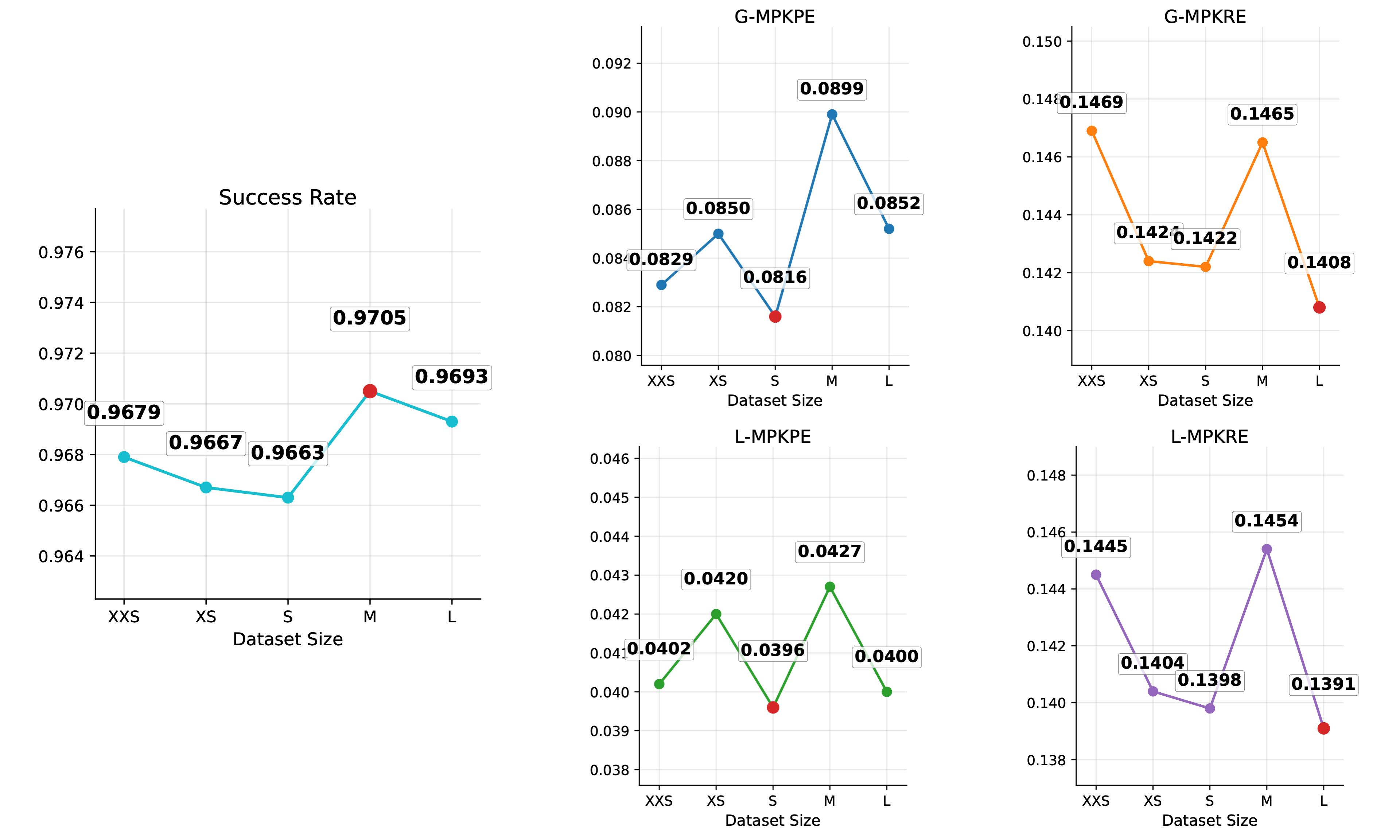
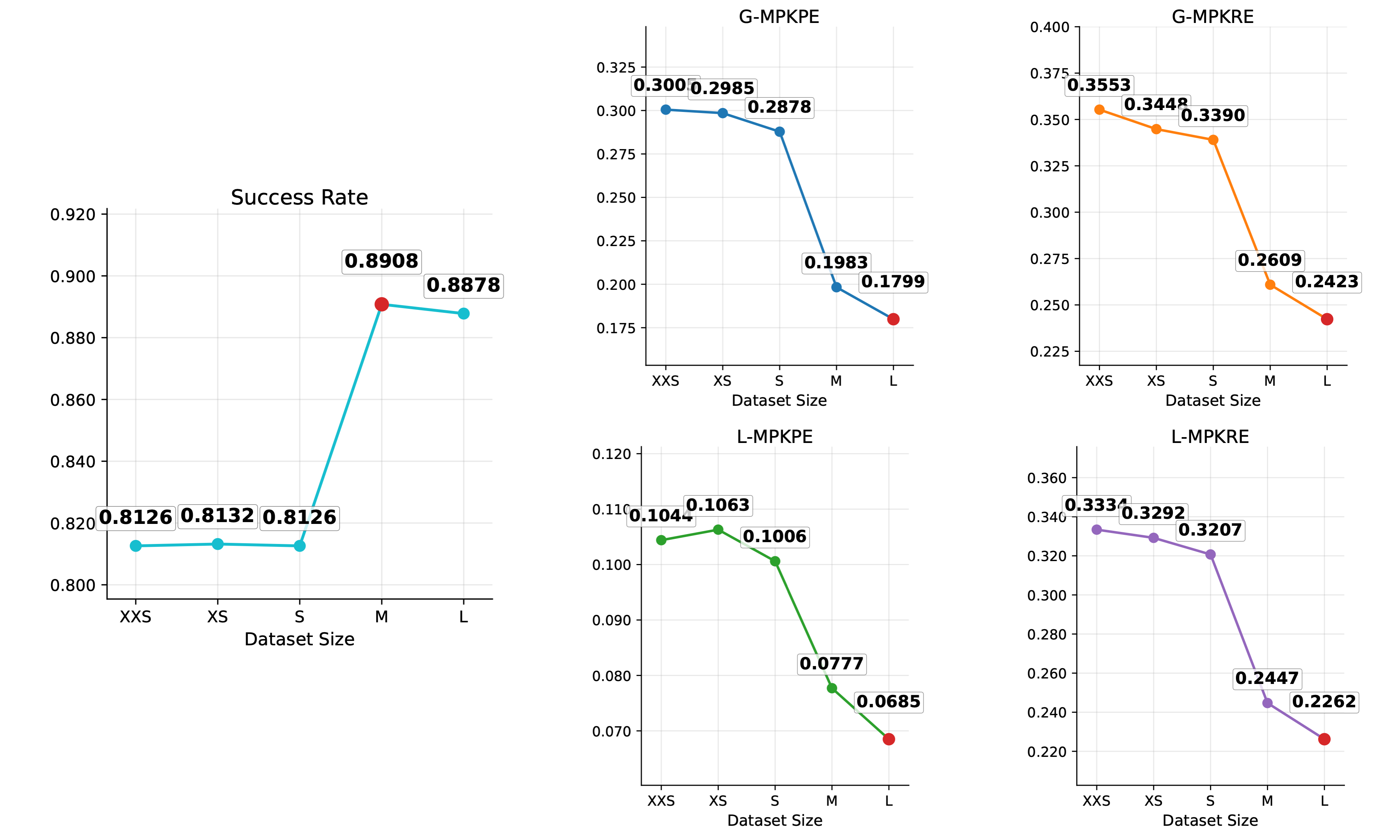
Scaling reference motions exhibits two distinct regimes. Homogeneous scaling, which increases the amount of in-domain data without substantially expanding behavioral coverage, provides only marginal performance improvements. In contrast, heterogeneous scaling, which introduces diverse data sources and significantly expands behavioral coverage, yields substantial gains on out-of-domain benchmarks while offering little additional benefit on in-domain evaluation. These results suggest that the effectiveness of reference-motion scaling depends not only on data quantity but also on behavioral coverage and its relevance to the target tasks, highlighting diverse behavioral patterns as a strong foundation for BFM pretraining.
Scaling Model
Mode
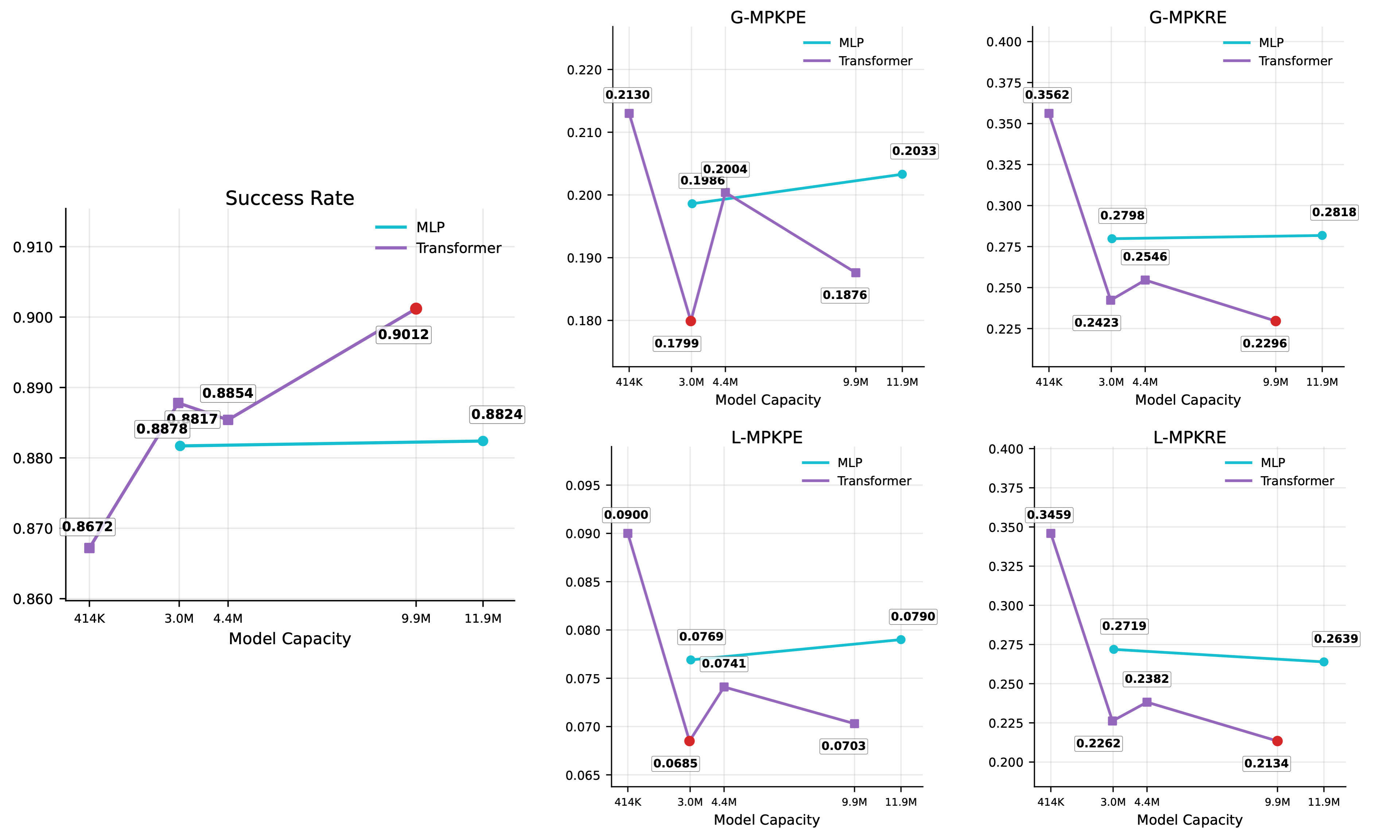
Mode
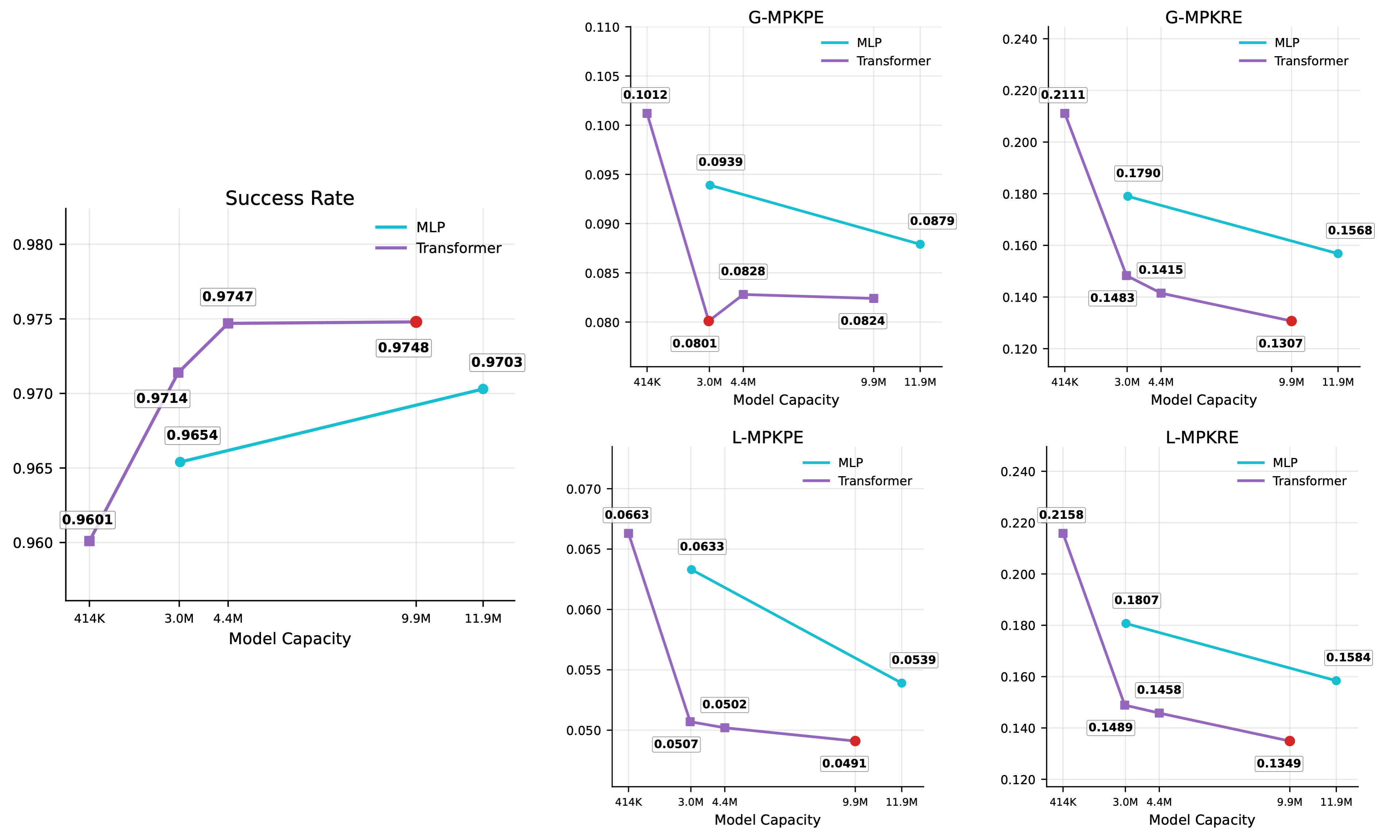
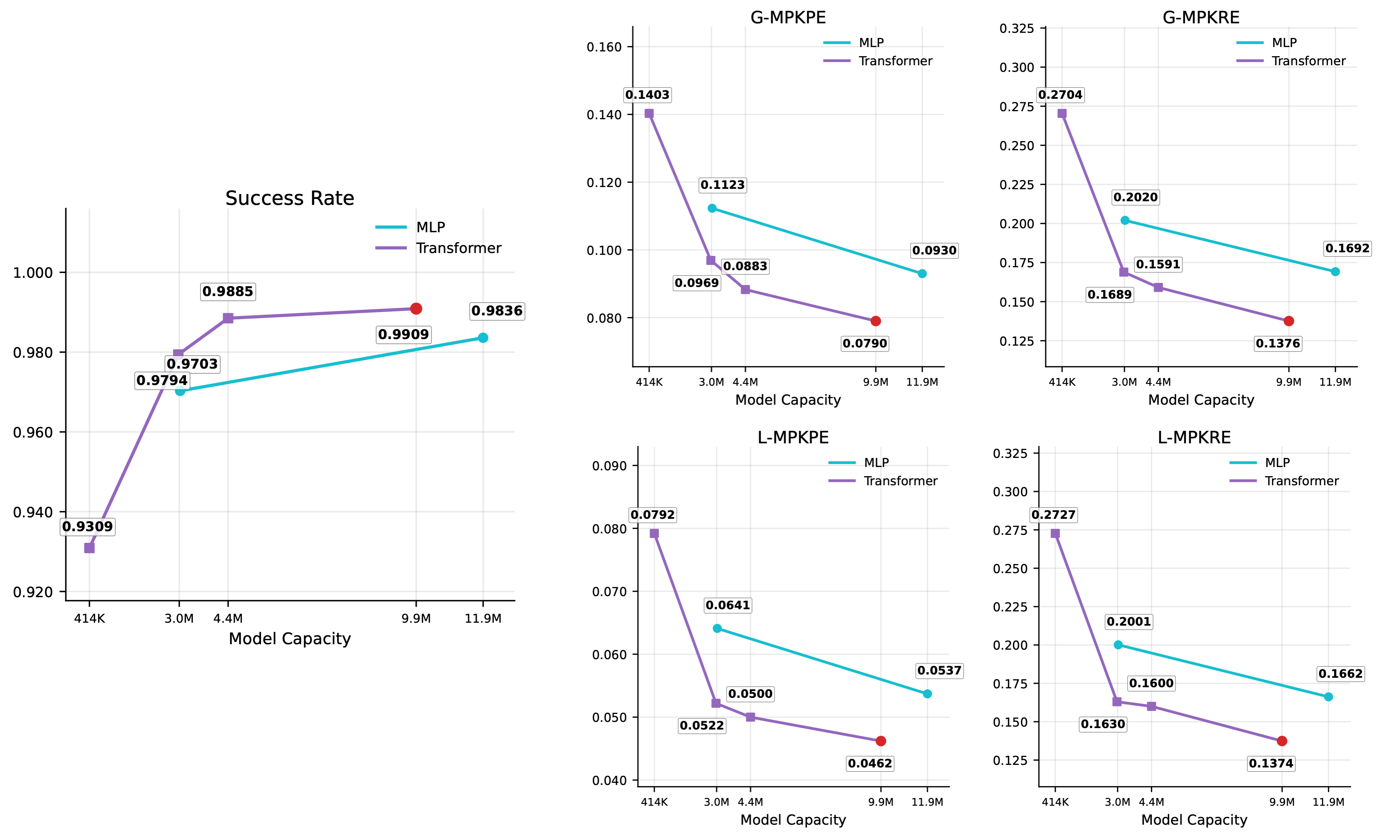
Mode
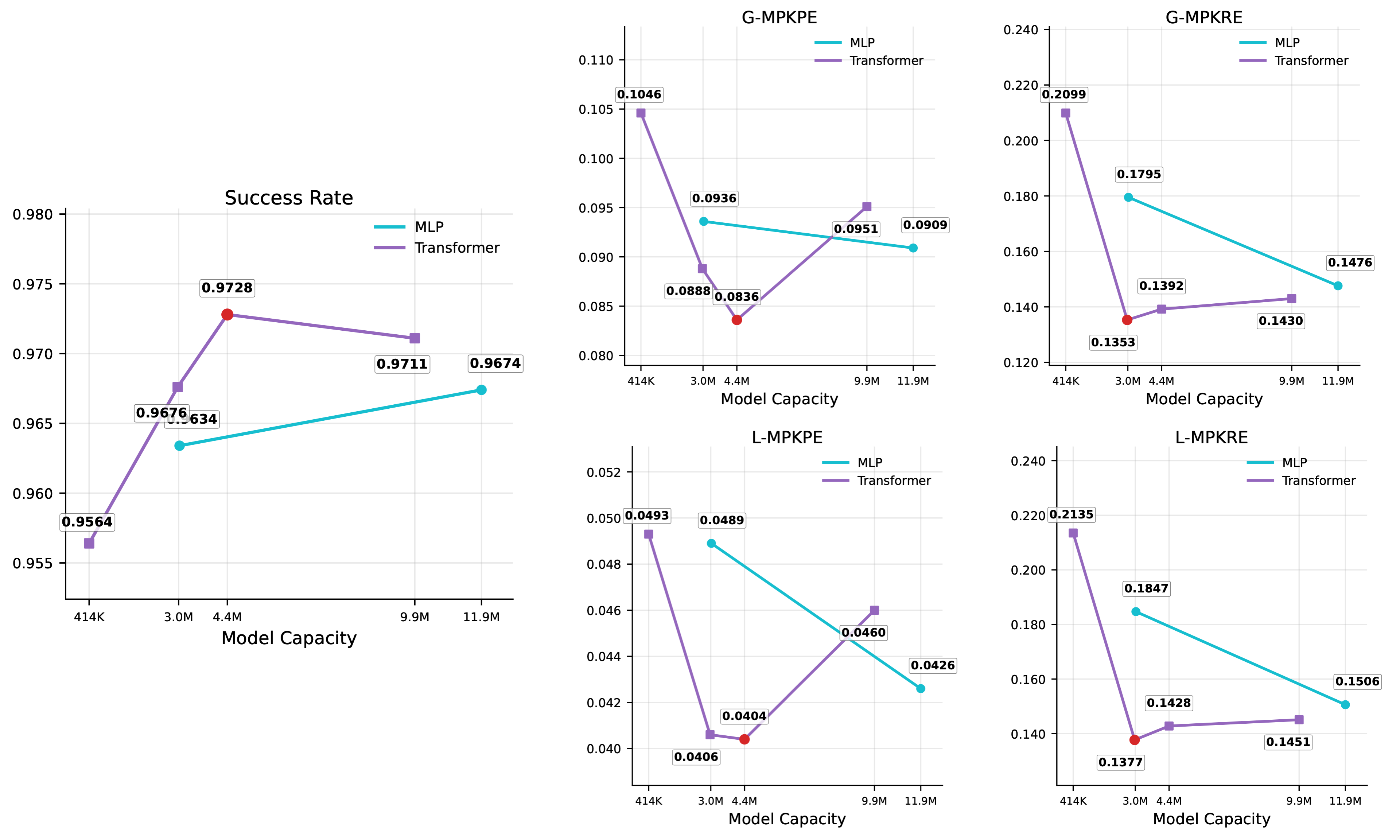
Mode
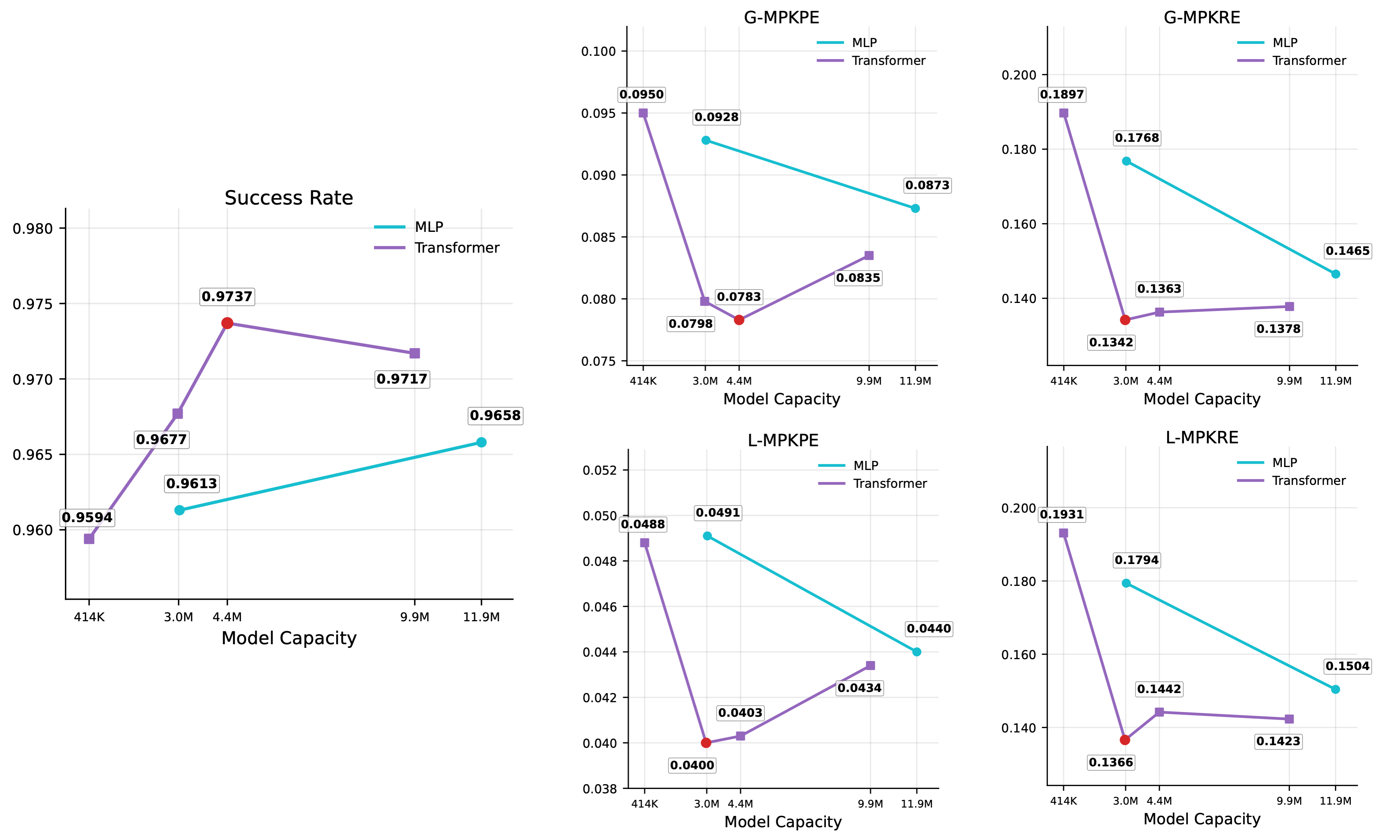
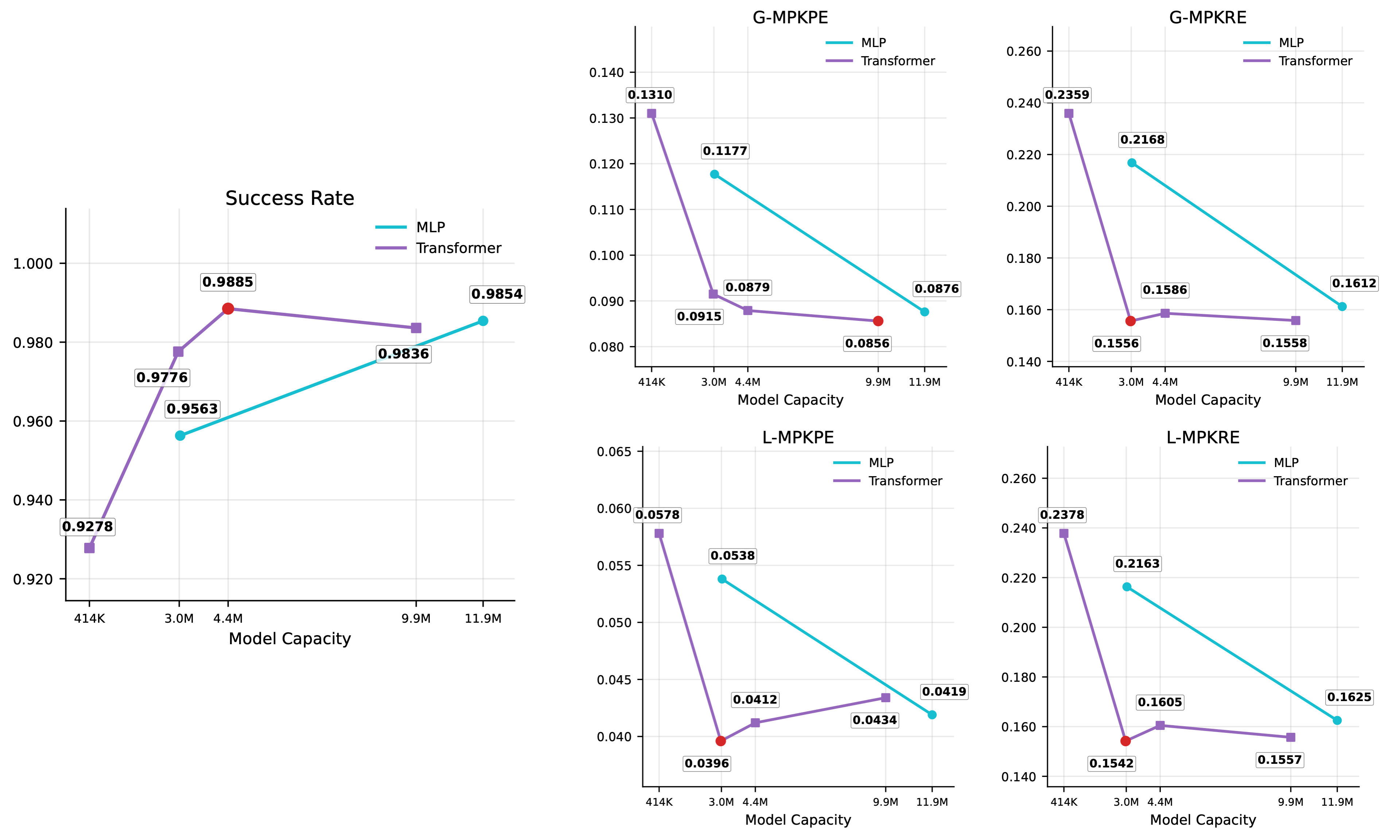
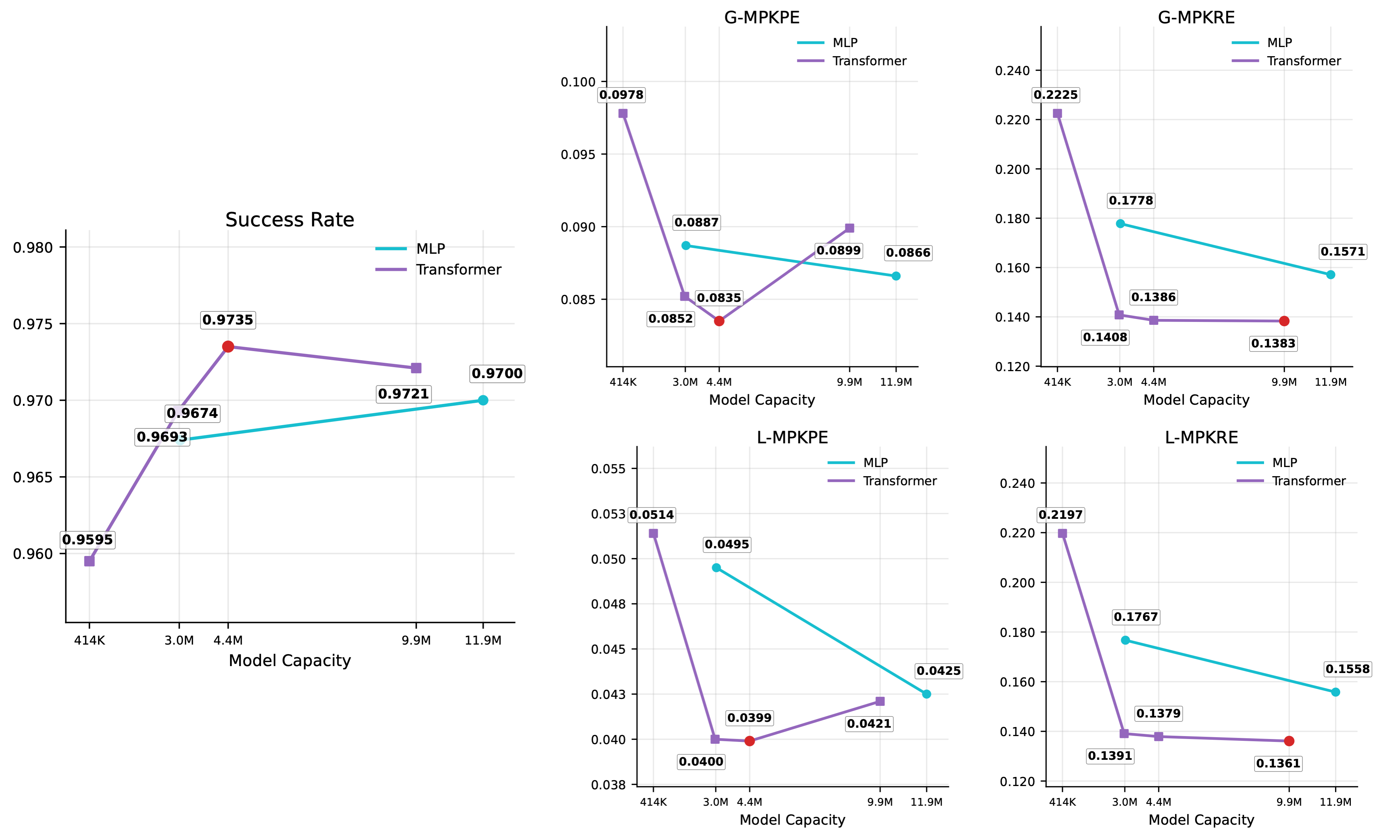
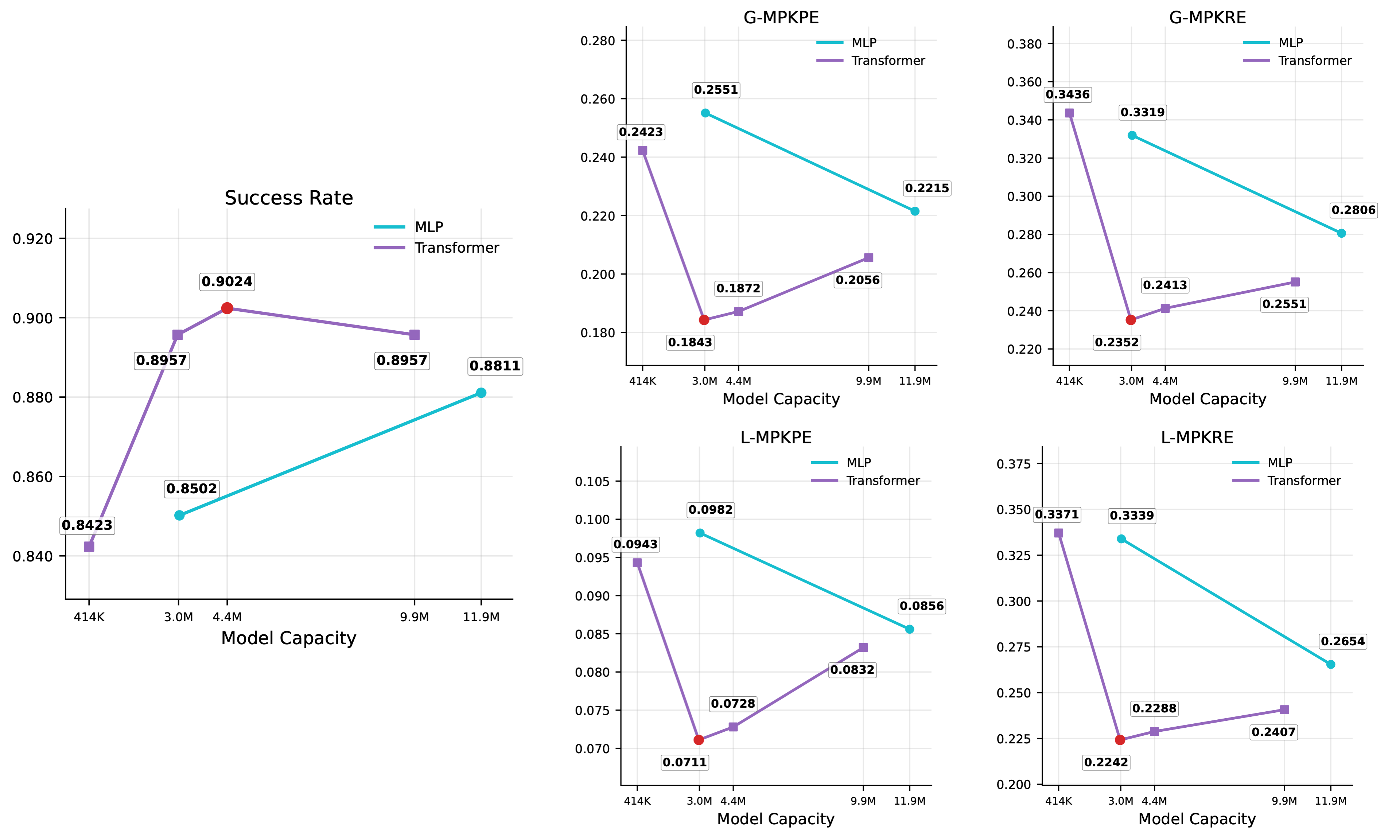
The proposed Humanoid Transformer consistently outperforms the conventional MLP across diverse control modes, with a medium-sized Transformer already matching or exceeding the performance of a substantially larger MLP. These results demonstrate that a more expressive architecture provides a stronger backbone for BFM pretraining by utilizing model capacity more effectively. Nevertheless, scaling the Transformer exhibits diminishing returns and mode-dependent saturation, suggesting that performance is increasingly limited by optimization trade-offs across control modes rather than model capacity alone.
Latent Analysis
The proposed Humanoid Transformer naturally learns structured latent representations without auxiliary objectives, exhibiting locality, global organization, and robustness to moderate perturbations. Moreover, increasing model capacity leads to convergence of latent representations across different control modes, suggesting that richer shared behavioral representations emerge as BFMs scale. This convergence may underlie the observed mode-dependent scaling behavior, where improvements in some control modes are accompanied by slight degradation in others due to stronger coupling within the shared latent space.
Conclusion
In this paper, we present a systematic investigation of the scaling behavior of Behavior Foundation Models for humanoid robots by revisiting three fundamental aspects: the learning paradigm, behavioral data, and model architecture. Through extensive empirical studies, we derive an effective scaling recipe that yields substantial improvements in control fidelity, execution robustness, and generalization capability. Nevertheless, the proposed framework has its limitations. Although we curate a unified control interface with diverse control modes, it remains unclear whether this interface is the most appropriate abstraction and how these modes should be integrated with future high-level policies. Consequently, the design of BFMs should continue to evolve alongside advances in high-level policy learning. Moreover, the current infrastructure for BFM pretraining remains relatively preliminary and constrained, limiting its scalability to broader settings. We hope that this work provides a foundation for systematic development of BFMs, ultimately contributing to the realization of general-purpose humanoid intelligence.
BibTeX
@article{zeng2026scaling,
  title={Scaling Behavior Foundation Model for Humanoid Robots},
  author={Zeng, Weishuai and Yin, Kangning and Niu, Xiaojie and Lu, Shunlin and Zhong, Weixiang and Chen, Jiahe and Jia, Feiyu and Chen, Xiao and Wang, Zirui and Xu, Furui and Zhou, Ming and Li, Kailin and Zhang, Weinan and Wang, He and Yi, Li and Lin, Dahua and Pang, Jiangmiao and Wang, Jingbo},
  journal={arXiv preprint arXiv:2607.15163},
  year={2026}
}From motion tracking to reusable behavior
BFM pretraining is instantiated as a goal-conditioned reinforcement learning problem, with humanoid whole-body motion tracking used as the proxy task. Motion tracking is not the final control objective; it turns behavior learning into a concrete and measurable control problem while keeping the control interface separate from one fixed form of command.
The tracking recipe requires the robot to reproduce reference motions as integrated whole-body trajectories in the global frame. Removing root-position tracking can give nearly identical guidance to behaviors with distinct global semantics, such as walking forward and marching in place, while decoupling root following from local pose tracking can compromise coordination between root and pose evolution.
Data scaling is not just more clips
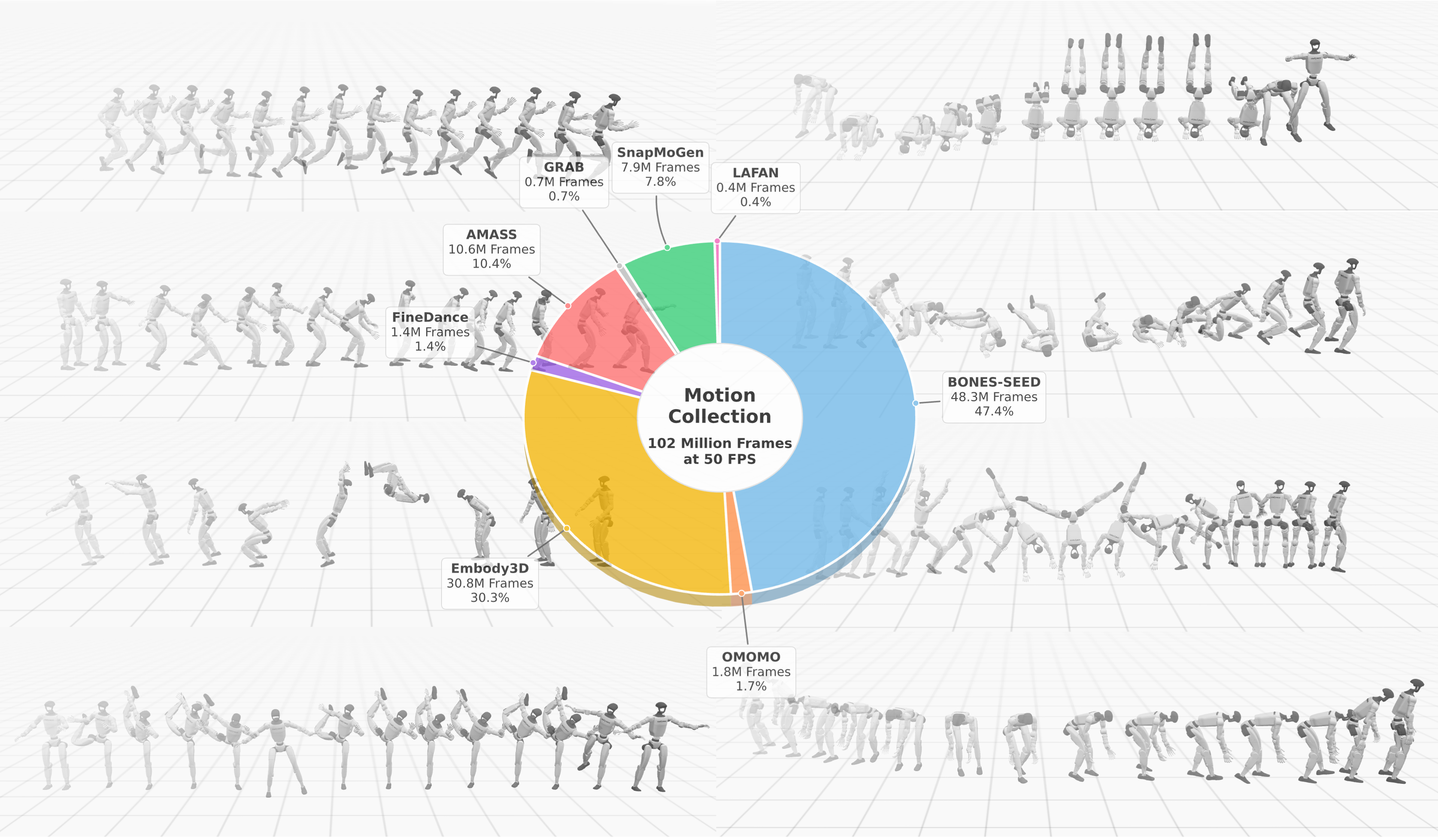
Under PPO-based motion tracking, training data scale has two sides: quantity and diversity. Effective training data are the on-policy rollouts collected through environment interaction, whose scale is governed by environment parallelism and rollout horizon. Reference motions shape the rollout distribution by introducing a wider range of behavior patterns for imitation.
ScaleBFM builds its reference corpus from a large-scale human motion collection with 102 million frames at 50 FPS, aggregated from multiple open-source motion datasets and then retargeted to the target humanoid. The dataset figure below shows the sources and broad behavior coverage used for this reference motion diversity.

Scaling results
The experiments report success rate and tracking errors under diverse control modes. For on-policy data scaling, the width of interaction increases with the number of parallel GPUs, while the depth increases with the rollout horizon of each environment. Representative modes include the root-and-hand mode, root-and-end-effector mode, root-and-upper-body mode, and whole-body control mode.
The scaling results cover the BONES Test Set and the Ours Test Set under whole-body control mode. The evaluation protocol reports global and local tracking errors over the activated links specified by each control mode.


Behavior videos
The videos below follow the main behavior and control axes: dexterous manipulation, natural and agile locomotion, whole-body coordinated loco-manipulation, real-world tracking, global control mode, local control mode, and the eight curated control modes used to present the same reference behavior through diverse behavior specifications.
Whole-body coordinated loco-manipulation
This group shows the whole-body coordinated loco-manipulation category alongside dexterous manipulation and natural locomotion, matching the broad behavior spectrum covered by ScaleBFM.
Badminton whole body local
Book whole body local
Bottle garbage whole body local
Bottle whole body local
Bottle2 whole body local
Carry run whole body local
Collect shirts whole body local
Dog arrangment whole body local
Dogs whole body local
Flower whole body local
Fruit collect whole body local
Hip closet whole body local
Laybed whole body local
Plug facing whole body local
Plug focus whole body local
Pour water whole body local 1
Reach high whole body local
Rice boiler whole body local
Shopping whole body local
Unplug facing whole body local
Unplug focus whole body local
Real-world tracking examples
Real-world validation covers tracking, goal reaching, reward optimization, and disturbance rejection. Real-world tracking examples include styled walking, highly dynamic dances, fighting and sports, and frequent turning during walking; this group collects locomotion-style videos under the same tracking-oriented behavior validation.
Slow run whole body local
Bent cross whole body local
Circle walk whole body local
Crossover whole body local
Crouch walk whole body local
Eight walk whole body local
Fast backward whole body local
Fast walk whole body local
Goose step whole body local
Greetings whole body local
Jump whole body local
Leg stretch whole body local
Musician whole body local
Punch whole body local
Random run whole body local
Run backward whole body local
Run whole body local
Shaking legs whole body local
Sidestep whole body local
Simple balance whole body local
Simple kick whole body local
Slow backward whole body local
Slow sidestep whole body local
Squat handshow whole body local
Squat turn whole body local
Squat walk whole body local
Stand up whole body local
Stretch whole body local
Tai chi whole body local
Tiptoe whole body local
Turn around fast whole body local
Turn around whole body local
Waist whole body local
Walk twice whole body local
Global-frame tracking in the real world
In global control mode, root localization aligns the root position on the xy-plane and the heading direction of control signals with the robot. These clips correspond to that global-frame tracking setting.
Circle walk
Circle walk real-to-sim
Global sidestep
Global sidestep real-to-sim
Global walk
Global walk real-to-sim
Global walk twice
Global walk twice real-to-sim
Vive tracker installation
Whole-body mode
Whole-body mode is the most fully specified interface in the curated control set. It activates 14 target links, covering the pelvis, shoulders, elbows, hands, torso, hips, knees, and feet, so the target describes nearly the entire humanoid pose rather than only a sparse subset.
Boxing whole body global
Circle walk whole body global
Slow run whole body global
Upper body whole body global
Walk whole body globald
Root Mode
Root Mode activates only the pelvis target and leaves all non-pelvis links unspecified. The controller therefore receives the coarsest global cue in the curated set, while the remaining body motion is filled in through behavior inpainting under sparse control signals.
Circle one point global
Intro one point global
Rest pose adjustment
Run one point global
Squat one point global
Turn around one point global
Walk twice one point global
Walk1 one point global
Bimanual Mode
Bimanual Mode activates only the left and right hand targets. In this setting, the hands are specified while the root and lower body are left to be completed by the policy, making it a compact interface for upper-limb-conditioned behavior.
High knee two point global
Run two point global
Squat two point global
Turn around two point global
Upper body two point global
Walk twice two point global
Walk two point global
Root-and-Hand Mode
Root-and-Hand Mode adds the pelvis target to the two hand targets. Compared with Bimanual Mode, it anchors the body root while still leaving the legs and torso mostly unspecified.
Backward three point global
Circle three point global
Getup three point global
Random walk three point global
Run three point global
Squat three point global
Turn around three point global
Upper body three point global
Walk three point global
End-Effector Mode
End-Effector Mode constrains the four end effectors: left hand, right hand, left foot, and right foot. It specifies where the extremities should go while leaving the pelvis and torso to be inferred from the learned whole-body behavior.
Boxing four point global
Crouch walk four point global
Greetings four point global
High knee four point global
Random walk four point global
Sidestep four point global
Slow run 2 four point global
Slow run four point global
Squat four point global
Turn around four point global
Turn four point global
Upper body four point global
Walk four point global
Walk twice four point global
Root-and-End-Effector Mode
Root-and-End-Effector Mode anchors the root together with both hands and both feet. This gives the policy a denser scaffold than End-Effector Mode while still avoiding full whole-body target specification.
Backward five point global
Bottle five point global
Boxing five point global
Circle five point global
Crouch walk five point global
Fruit five point global
Slow run five point global
Squat five point global
Stretch five point global
Tai chi five point global
Turn around five point global
Upper body five point global
Walk five point global
Local control mode
Local control mode re-anchors the target to the robot's current root state instead of relying on external root localization. It preserves the heading-alignment procedure while interpreting the incoming control signal relative to the robot.
Back forward run five point local
Boxing five point local
Boxing2 five point local
Boxing3 five point local
Cartwheel five point local
Circle walk five point local
Cross run five point local
Crouch walk five point local
Fast run five point local
Fast walk five point local
Flowerhand five point local
Greetings five points local
Random walk five point local
Run five point local
Sidestep five point local
Squat turn five point local
Standup1 five point local
Standup2 five point local
Tai chi five point local
Turn around five point local
Walk five point local
Takeaways
- ScaleBFM is organized around three ingredients: the learning paradigm, behavioral data, and model architecture.
- The learning paradigm is motion tracking formulated as reproduction of integrated whole-body trajectories in the global frame.
- The control interface uses eight curated control modes, allowing the same underlying reference behavior to be presented through diverse behavior specifications.